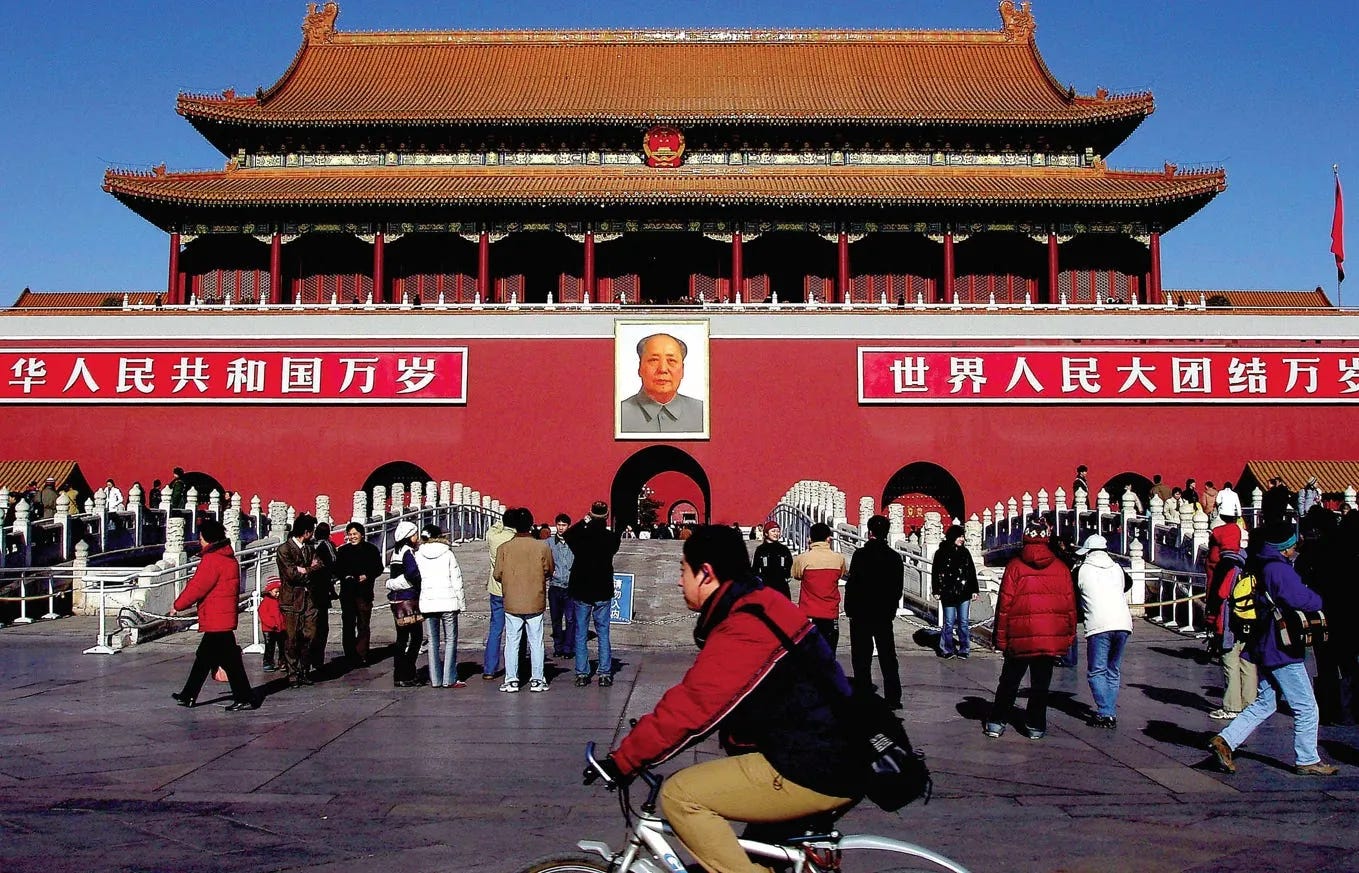
The Beijing Bazaar
It’s not about trade deals or diplomacy. It’s about diplomatic trade in strategic commodities and global growth.

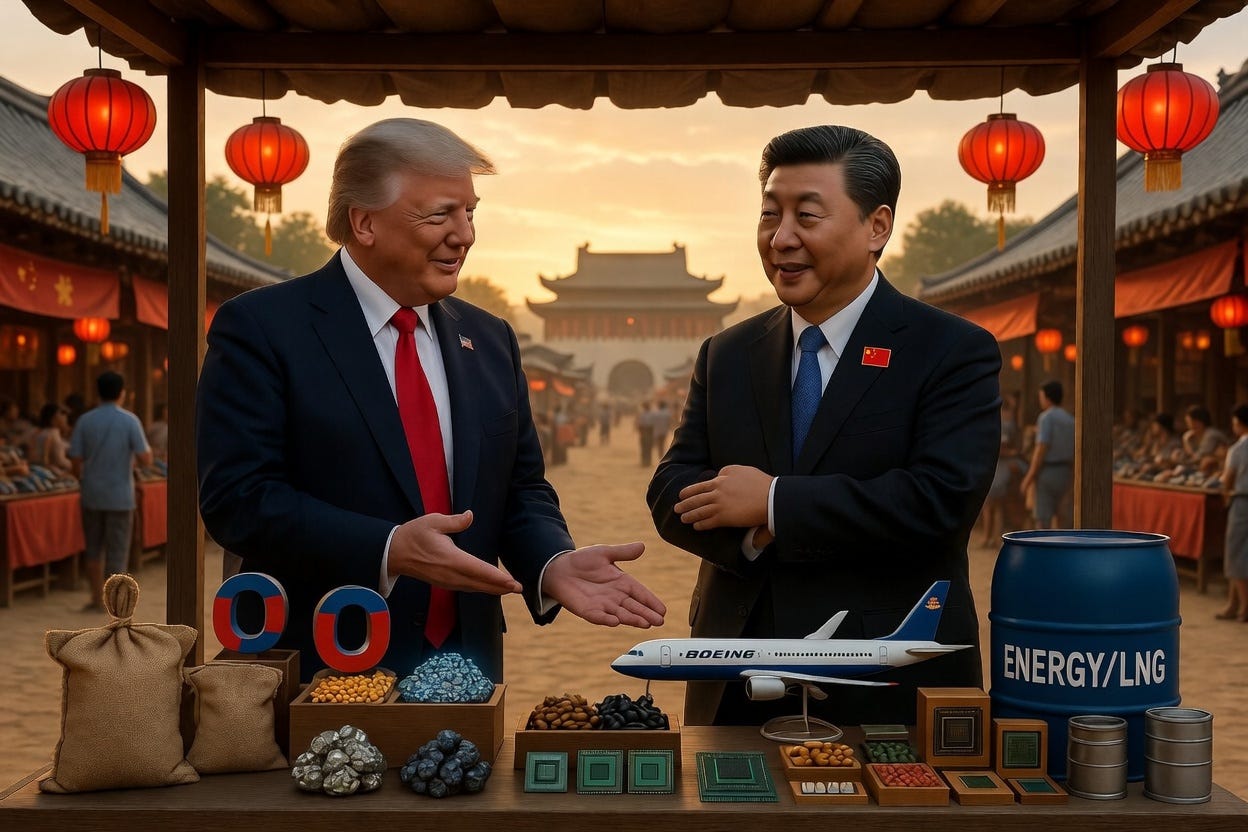
The upcoming Summit in Beijing is not primarily about grand diplomacy, abstract “stabilization”, or soybean purchases. It is about transactional diplomacy in strategic commodities, recalibrating supply chains, and delivering tangible stimuli to two large, stressed economies. In an era of managed rivalry, horse-trading remains the most reliable lubricant. For the first time in a long time, conditions are ripe for real progress where history might look back and call it a turning point in the bilateral relationship.
The China-watching commentariat; academics, think-tank analysts, and Twitter synthesizers have coalesced around a sober consensus: the upcoming May 14-15 summit in Beijing between President Trump and President Xi Jinping will yield little beyond optics. Success, many suggest, will be measured by the mere fact that it occurs without incident, perhaps accompanied by the usual agricultural purchases and aircraft orders. History, they imply, will record another chapter in competitive coexistence, not a turning point.
This view is not unreasonable given the structural headwinds: technological decoupling, military modernization, and clashing regional visions. Yet it risks underestimating the agency of two strong, deal-oriented leaders and the changed material conditions since their October 2025 meeting in Busan. Pragmatism, not ideology, defines the current moment. As those of us witnessing China’s rise over the past decades have long understood, the U.S. and China are not going anywhere. The art lies in structuring their interdependence to avoid mutual impoverishment.
From Busan Baseline to New Realities
Recall the October 2025 Busan understanding. Amid rising tensions, the two sides de-escalated: China paused aggressive export controls on rare earth elements and critical minerals, committed to curbing fentanyl precursors, removed a few exit bans, and resumed substantial purchases of U.S. soybeans. The U.S. trimmed certain tariffs, including the “fentanyl tariff,” and offered limited reprieves on other measures. Working groups continued. Red lines were clarified.
The world has since shifted markedly, mostly due to developments in the Middle East. The U.S.-Israel conflicts with Iran have depleted U.S. munitions stockpiles, disrupted energy flows, strained global shipping, destroyed oil, gas, chemical and fertilizer infrastructure, and generally elevated energy prices (and let’s not forget Russia/Ukraine and Venezuela). These pressures create fresh incentives. Both leaders face domestic economic calendars that reward visible wins: Trump ahead of midterms, Xi amid the perennial challenges of slowing growth, demographics, and “high-quality development.”The consensus under-weights these incentives. Summits between strong executives often succeed not through ideological convergence but through calibrated exchanges. Think Nixon-Mao in 1972: derided by many at the time as premature theater, yet a genuine realignment. Or earlier Trump-Xi encounters, where theatricality masked groundwork for transactional progress. The risk today is not naive optimism but a performative skepticism that blinds us to low-hanging fruit.
Optics and Leverage: A Mutual Performance
Optics strongly favor a cordial tone. Trump, having aggressively deployed tariffs, sanctions, and military posturing across multiple theaters including Russia/Ukraine, Venezuela, and the broader Middle East, needs visible deliverables to sustain a narrative of economic resurgence and strength. With inflation concerns lingering and midterm politics approaching, these wins matter. Xi, in turn, can provide the perfect stage in Beijing: presidential photo-ops in the heart of the Middle Kingdom that project gravitas, stability, and deal-making prowess for both leaders.Both men fully understand the value of appearing “close” on camera; so long as substantive outcomes follow.
Yet Trump arrives with a noticeable air of vulnerability. Domestic setbacks including court rulings striking down key tariffs, signs of erosion in his MAGA base over foreign entanglements, the ongoing controversy surrounding the unreleased Epstein files, and other liabilities, have weakened his position. President Xi will sit back, read the room astutely, and extract a high but fair price for cooperation.Beneath the pageantry lies a classic bazaar bargain.
China’s resilient but challenged economy would benefit from reduced tariff frictions and greater predictability. The United States needs reliable access to critical inputs and supply chain stability. Each side holds chips the other wants and both know exactly what they are willing to trade, and at what price.
Rare Earths and National Security Imperatives
At the top of the U.S. list: reliable flows of rare earth elements and permanent magnets. Munitions expended in the Russia/Ukraine and Israel/Iran/Gaza/Lebanon conflicts have drawn down stockpiles; rebuilding defense inventories is a national security priority. These materials are equally vital for automobiles, renewables, and advanced manufacturing revival at home. Beijing’s export licensing regime has acted as a governor; tightened at times of tension, loosened for leverage. Opening it wider serves Chinese exporters (higher volumes and margins under license) while addressing U.S. bottlenecks. A win-win, albeit one where Beijing will seek reciprocal gestures such as semiconductor sales, or delayed delivery for weapons systems deals for Taiwan, or rhetorical reaffirmations on the sensitive political issue of the One-China policy, where words come easier than actions. After all, words flow easily from President Trump and they don’t make the money printer go brrrrrrr.
Expect announcements or quiet extensions of the Busan pause, potentially with enhanced licensing predictability for commercial users. Signs will emerge in subsequent months through contract flows and inventory data. If China views the US as not following through on agreements, this will be the first governor to again be tightened.
Semiconductors, Boeing, and Beyond
U.S. export controls on advanced semiconductors and lithography have slowed but not halted Chinese progress, which has been tremendous. Domestic innovation and transit workarounds have narrowed gaps in key areas, even as U.S. firms lament lost market share. A pragmatic easing in non-sensitive segments could unlock sales without compromising core advantages. Boeing’s CEO and many, many, other executives joining the trip signal multiple deals including aircraft orders; the go-to deliverables that employ American workers and maintain Wall Street share values.
Deeper, less public understandings are plausible: working groups on joint ventures, technology-sharing frameworks in select civilian domains (e.g., EVs or legacy nodes), managed investment channels, AI governance. These would not dissolve rivalry but channel it productively.
The Broader Stimulus Play
The most compelling case for an inflection lies in macroeconomics. Global conditions, including rising energy costs post-Iran and lingering inflation, cry out for stimulus without excessive monetary expansion. Bilateral tariff reductions, quota-based managed trade in select sectors, and incentives for two-way investment could deliver a tidal wave of activity. U.S. agricultural and energy exports (LNG, coal) help Beijing diversify sources; Chinese purchases and supply-chain stabilization aid U.S. reindustrialization. Neither side “wins” decisively, but both harvest gains. This is precisely the transactional logic that has stabilized the relationship at prior stress points.
Much will remain unannounced: quiet commitments on enforcement, future working group mandates, or reciprocal de-risking steps. Markets and analysts will discern them through data in the weeks and months ahead: export volumes, licensing approvals, investment filings. China’s currency valuation will no doubt be discussed.
Bull in a China Shop as the Elephant in the Room
Of course, there are other diplomatic arenas where cooperation is both necessary and mutually beneficial: North Korea, Japan, Taiwan, the Russia-Ukraine conflict, Israel and the broader Middle East; and most pressingly, Iran and the Strait of Hormuz.
Each country will naturally bring its own wish-list of requests, areas where the other can usefully take action or exert leverage in ways that help both sides’ interests.
As an aside, the U.S. has already positioned significant military assets in the Middle East in anticipation of launching a new offensive round. If Trump approaches the Beijing summit in good faith, he is likely to hold escalation in check at least until after his meeting with Xi, giving diplomacy a genuine window to succeed.
However, if the meeting falls short of expectations and he pulls the trigger on escalation either before or during his time in Beijing, it would be the equivalent of flipping the chessboard and destroying any realistic hope of meaningful agreement.
A Horse Trade, Not a Grand Bargain
Red lines will be respected, not erased. Yet that is the point: this summit is not about resolving the rivalry but rendering it less mutually destructive while harvesting concrete domestic economic gains for both sides. In a world of great-power competition, pragmatic deals that rebuild depleted stocks, stabilize energy and food flows, and stimulate growth without printing presses represent progress.
Looking Forward
Foreign policy sophisticates and capital allocators should watch not for revolutionary communiqués but for the quiet recalibration of the incentives that drive policy: both foreign and domestic. History often marks inflection points retrospectively; when transactional horse-trading quietly lowered the temperature and unlocked value. The Beijing Bazaar may prove one such moment. Those betting solely on perpetual escalation risk missing the arbitrage. The relationship remains competitive. But competition, intelligently managed through deliverables, beats unmanaged drift or sabre-rattling. Both leaders, in their distinct idioms, appear to grasp this. The rest of us should calibrate expectations accordingly: neither naively high nor reflexively low, but transactionally pragmatic and realistic.